Citing an unnamed insider "privy to BMW's plans," Auto car is reporting today that BMW's previously announced focus on green technology will yield the BMW Z10 ED, a flagship that will showcase new drive lines, electronics and body construction. The Z10 ED will be a two-seater costing around $105,000, developed by BMW's Technic division, and sold in limited numbers.
By utilizing its carbon fiber construction techniques, BMW intends the Z10 to weigh no more than 3,087 pounds. Moving forward from just carbon fiber body panels, BMW's engineers have found a way to combine several pieces of the frame into a single sub-assembly. They are also exploring integrated door frames and sill panels to lower curb weight and improve rigidity.
Engine possibilities include a high-pressure turbocharged direct-injected straight six-cylinder making a projected 400-hp. That engine could replace the 3.0-liter in the current BMW lineup. The engine has been conceived in two variations: a conventional mechanical valve system with BMW's VANOS variable valve timing, and another with an electronic valve control that allows a variable compression ratio.
The Z10 ED will also feature stop-start technology, a generator, and brake energy regeneration engineered to story energy in a lithium-ion battery. All of these technologies will filter down to the higher volume BMW models, if all goes according to plan.
With the Subaru Hybrid Tourer Concept, Subaru has condensed its DNA, developed over many years around the Subaru's core technology of "Symmetrical All-Wheel Drive (AWD)" and "Horizontally-Opposed Boxer Engine", into the integration of a luxurious and high-quality cabin atmosphere and an eye-catching sculpted body. The Subaru Hybrid Tourer Concept features Subaru's latest evolutions in handling agility, riding comfort and superior safety performance. It proposes Subaru's vision of a future grand touring car that excels in environmental friendliness thanks to Subaru's unique hybrid system.
The Exterior
Subaru imagined wings with a feeling of freedom and confidence for driving far and wide in any environment. A luxurious and comfortable cabin, and advanced driving performance are contained within a sculpted aerodynamic form. The design features a combination of bright, open glass areas with a solid, reliable body.
The Interior
The original point of the ideal grand touring car is its interior design, featuring four independent and comfortably positioned seats. Passengers are enclosed within an atmosphere that provides a surpassing feeling of openness and stress-free reassurance, through the further pursuit of a human-centered philosophy, the essence of Subaru car design, and the incorporation of functions that are friendly to passengers.
* The top of the dashboard is movable up and down to provide an optimal driving environment for the driver according to driving conditions.
* A flat floor in the rear seat was achieved even with the implementation of AWD, for improved use and movement inside the cabin.
* Specialized shielding is incorporated in the windshield to reduce eyestrain on the driver.
* New leather covering developed with superior breathability and a ventilation function is used in the seats for improved comfort and texture.
The main innovative operating feature of the Peugeot RD Concept car is its ingenious system of articulation that provides irreproachable road holding allied with the ability the easily thread its way through urban traffic.
Equipped with an environmentally friendly electric motor, the driving position in this single-seat concept offers a new feeling of freedom, thanks to its panoramic vision, voice-message driving assistance and a heads-up display system that gives all the information required for travelling in complete safety.
This concept car combines the sensations of a 3-wheeled scooter with the driving pleasure of a saloon car, while retaining all the essential functions of both modes of transport... and while adding a silent environment.
As you would expect, being accessible, solid and extremely simply designed, the Peugeot RD Concept car fits perfectly with the complicated mobility constraints you would encounter in a megalopolis of the future.
With the Cadillac Converj Concept General Motors unveiled a further glimpse at the potential of electric propulsion, this time in the form of luxury transportation. The Cadillac Converj was developed as a well-appointed grand touring coupe with a bold design and a host of interactive technology.
Cadillac's extended-range electric vehicle (E-REV) concept has a new body style that is an evolution of the brand's traditional Art and Science design theme.
Voltec - innovative propulsion technology The Cadillac Converj's Voltec electric propulsion system is made up of a 16-kWh, T-shaped battery, an electric drive unit, and a four-cylinder engine-generator. It uses electricity as its primary source to drive the car.
A thermally managed battery pack contains more than 220 lithium-ion cells that provide the primary power to drive the Cadillac Converj electrically up to 40 miles without using fuel or producing tailpipe emissions. The battery is integrated into the Cadillac Converj's chassis and stores electricity frol the grid when the vehicle is plugged in. It takes less than three hours to recharge the battery at 240V, or about eight hours from a 120V outlet.
When the battery's energy is low, the Cadillac Converj seamlessly switches to extended-range mode. During this secondary level of operation, electricity needed to power the vehicle is created on-board by a flex-fuel-powered engine that operates much like a home generator to create electricity.
Whether in electric or extended-range mode, the Cadillac Converj is propelled all the time by an electric drive unit. It converts electrical energy from the battery or the engine-generator into mechanical energy to drive the front wheels. It also delivers 273 lb.-ft. (370 Nm) of instant torque, for a quick launch, and 120 kW of power. The top speed is 100 mph. There is no compromise in vehicle performance in either mode of operation. To enhance the ride feel, the Cadillac Converj Concept also features GM's Magnetic Ride Control; and for even greater efficiency, energy during braking is captured and stored in the battery.
Pure Cadillac design : There's no mistaking the Converj for anything but a Cadillac, according to Lutz. "An aggressive, forward-leaning profile hints at a new, progressive theme and proportion in Cadillac's design evolution," he says. "The new proportion showcases a uniquely shaped, modern vision of a personal luxury 2+2." The overall shape is reinforced by a prominent, sweeping body line with large, 21-inch (front) and 22-inch (rear) wheels pushed to the edges of the body. The Cadillac Converj exterior is painted a dark silver tri-coat that GM designers dubbed "Reaction."
An all-glass roof incorporates solar panels that help offset power drain from the vehicle's accessories. Additionally, several aerodynamic and design efficiencies were incorporated to enhance the driving range, including: * A full under-vehicle cover (belly pan) * Minimal grille openings that reduce drag at the front of the vehicle * Low-profile rearview cameras replace conventional outside mirrors to reduce drag * Wheels are shaped to push air outward for smoother body side airflow The Cadillac Converj also incorporates vertical headlamp and taillamp elements, with light pipe tebhnology.
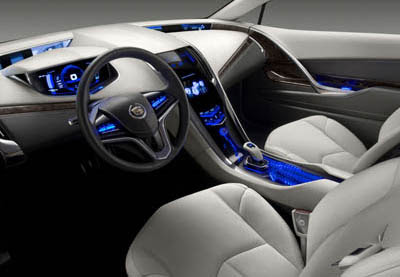
The Luxury meets technology inside The Cadillac Converj's interior has advanced features and luxurious appointments blending efficiency and environmental consciousness. The 2+2 configuration is trimmed in contrasting Winter White synthetic suede - including the top of the instrument panel - and Midnight Black leather, with polished aluminum and wood grain accents. Renewable materials are used throughout such as wool-blend carpeting, a headliner made from silk, suede made from post-industrial content and more.
A technologically advanced driver center increases efficiency and reduces the draw on the battery. Features include: * New, organic light-emitting diode technology used on reconfigurable instrument cluster * Touch-screen navigation, climate, center-stack controls and audio systems * Adjustable, overhead white ambient lighting * Unique "power on" sequence featuring blue-lit console graphics * Screen displays for features including regenerative braking, battery charge level and power output * No inside rearview or outside mirrors; cameras provide surrounding images on a screen placed high on the instrument panel for a full, panoramic view * Push-button ignition and power-folding front seats
The Audi RSQ is a mid-engined concept car developed for use as a product placement in the 2004 sci-fi movie I Robot. It is meant to depict a technologically advanced automobile from the year 2035.
This sports coupé is a visionary interpretation of Audi's typical automobile design. An important challenge presented to the designers was that despite its extreme character the car still had to be recognized by the audience as an Audi. To accommodate this demand, the engineers implemented a current Audi front-end design that includes a single-frame grille and the company's trademark overlapping rings.
The RSQ also includes special features suggested by movie director Alex Proyas. It utilizes spheres instead of wheels and its two butterfly doors are hinged to the C-posts of the body.
Though this kind of collaboration was a first for Audi, a similar project was developed by Lexus for use in the 2002 film Minority Report
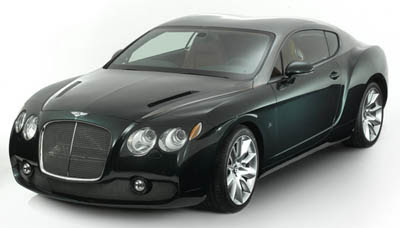
The Zagato Atelier takes great pleasure in introducing the Bentley GTZ, the latest in a long line of collaborations with the very best British car manufacturers over the Milanese Atelier 's 89.
Following on from the recent presentations of the Ferrari 575GTZ in 2006 and the Maserati GS Zagato at the Villa D'Este in 2007, the Bentley GTZ is a neo-classic Zagato interpretation of the style of a British GT.
The project was conceived during a discussion between Dr. Ing. Franz Josef Paefgen, CEO of Bentley Motors Limited and Dr. Andrea Zagato, President of Zagato at the Pebble Beach Concours D'Elegance in 2006. At a 'Tribute to Zagato' presentation, Zagato showed a selection of 50' 60's models, near by the recent berlinettas presented during the last 3 years. Dr. Paefgen was struck by the beauty of those cars and reminded of the historical significance of the art of the Carrozzeria (coachbuilders) which was both being maintained and carried forward by Zagato. Starting from the styling cues of the last neo classical coupes, which became milestones of Zagato design in the new millennium, the challenge was to apply the same design language to a completely different proportion of vehicle: the Bentley Continental GT Speed.
Even with many technical restrictions and carry-over parts in order to maintain the basic functions of this extremely sophisticated vehicle, the Zagato design team managed to give a distinctive and attractive character to the Zagato coupe.
Double-bubble roof, round tail with all new rear combination lamp are harmoniously integrated in to an imposing body adding a more aggressive and sharp feeling without losing the absolute solidity which is part of the great charm of the original coupe. The same time the hand painted pin-stripe coordinated with the interior colour adds a refined and exclusive elegance to the extrovert body lines helps to make the look of this car appropriate to be special limited-production model born between two great automotive cultures: Bentley and Zagato.
 Citing an unnamed insider "privy to BMW's plans," Auto car is reporting today that BMW's previously announced focus on green technology will yield the BMW Z10 ED, a flagship that will showcase new drive lines, electronics and body construction. The Z10 ED will be a two-seater costing around $105,000, developed by BMW's Technic division, and sold in limited numbers.





 Starting from the styling cues of the last neo classical coupes, which became milestones of Zagato design in the new millennium, the challenge was to apply the same design language to a completely different proportion of vehicle: the Bentley Continental GT Speed.